Writing Villains Who Want Something: An SFF Build Sheet

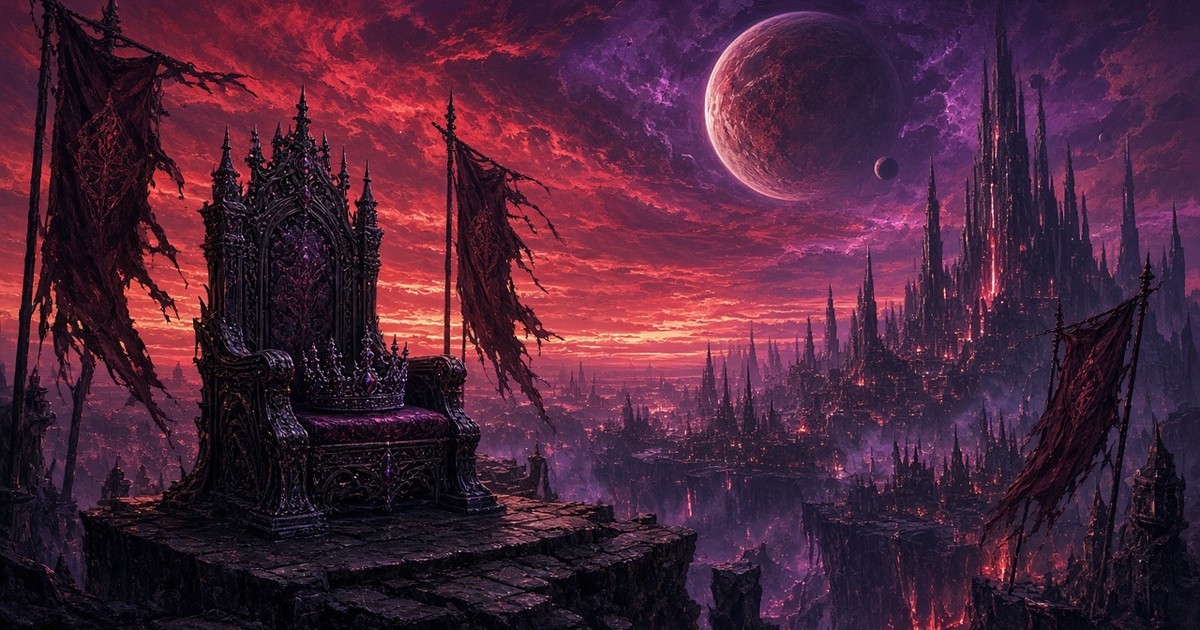
An empty obsidian throne with a dark crown on its seat overlooks a spired citadel and a looming moon under a crimson and violet sky, torn banners whipping in the wind.

By Jackson Dix

Most weak villains I’ve drafted had the same problem. They existed to be in the way. They showed up when the plot needed friction, said something menacing, and vanished until the next act. They had a costume and a body count. They did not have a goal.

A villain who wants something drives the story. The hero reacts, and every scene has two engines running instead of one. That’s the whole argument of this post. The rest is a method.

What follows is the build sheet I use when an antagonist feels thin. It runs in seven steps, and each step produces one or two sentences you can write on an index card. By the end you have a villain you can drop into any scene and know what they’d do there.

I’ll use two original illustrations along the way, one science fiction and one fantasy. I made both up for this post.

Step 1: Name the want in one concrete sentence

Write down what your villain wants. Then check it against one test: could a camera film the moment they get it?

“Power” fails. “Revenge” fails. “To destroy the world” usually fails too, because it’s a result, not a thing a person reaches for on a Tuesday. A concrete want has an object. A throne, a seat on a council, a cure, a child brought home, a colony ship turned around, a name struck from a record.

Illustration (SF). Warden Ilse Marrow runs the only orbital dock above a mining moon. She wants the moon’s last evacuation ship to stay docked for ninety more days.

Illustration (fantasy). Teodor Vane, a court archivist, wants the royal succession rolls to name his niece as heir before the old queen dies.

Both wants are small enough to picture. That’s the point.

Step 2: Write the reason they believe it

Next to the want, write why the villain thinks it’s right. Not why it’s evil. Why it’s right, from inside their head.

You’re looking for a belief, not a backstory dump. Backstory can come later and in pieces. The belief is the sentence the villain would say if you asked them at three in the morning and they were being honest.

Illustration (SF). Marrow believes the evacuation is a lie. The corporation will strand the miners on a worse rock, and ninety days is long enough for her to prove it.

Illustration (fantasy). Vane believes the rightful heir, the queen’s grandson, will start a war within a year. He has read three hundred years of the archive and he thinks he knows how this ends.

Notice that neither belief has to be true. It only has to be sincere.

Step 3: Set the price they will pay

Here’s where a villain stops being a mood and becomes a person. What is this character willing to give up to get the want?

Write down the most expensive thing they’ll sacrifice. Then write one thing they’ve already sacrificed before page one.

This step answers a question readers ask without knowing it: how far will this person go? If the villain has already paid something, the reader believes they’ll pay more.

Illustration (SF). Marrow has already falsified two safety reports, which ended her career the moment anyone checks. She’ll let a cargo hauler crash rather than release the docking clamps.

Illustration (fantasy). Vane burned his own published histories, twenty years of work, because they contradicted the forged rolls. He’d poison the grandson if forgery doesn’t hold.

The price also gives you a scale for the climax. If the reader has watched the villain pay, the final payment lands harder.

Step 4: Draw the line they won’t cross

Every villain worth writing has a limit. One act they refuse, even when it would win.

This line does two jobs. It makes them human, because people have limits. And it hands your hero a lever. The protagonist can push the villain toward that line and force a choice between the want and the self.

Illustration (SF). Marrow will not harm a miner. The whole plan exists to protect them. If the hero can show that keeping the ship docked puts miners at risk, Marrow has to decide which version of herself survives.

Illustration (fantasy). Vane will not harm his niece, and he won’t let her know what he’s done. If she finds out, he loses the thing he wanted the throne to protect.

Famous villains often have a line like this. Darth Vader’s attachment to his son, revealed late in the original trilogy, works this way: a limit the reader didn’t see coming that turns the final confrontation.

Step 5: Build the plan and the clock

A want with no plan is a wish. Give the villain a plan with steps, and give the plan a deadline.

Write three to five steps. Keep them practical. Who do they need to bribe, threaten, recruit, or fool? What resource do they need that they don’t have yet? Then write the clock: the event that makes the plan fail if it isn’t finished in time.

The plan is your outline’s second spine. Each step is a scene the villain is working on while the hero works on something else. When the hero disrupts a step, the villain adapts, and you get a twist that makes sense afterward.

Illustration (SF). Marrow’s plan: delay the ship with a fake hull inspection, leak data to a journalist on the inner planets, keep the corporate auditor occupied, and survive until the journalist’s story breaks. Her clock is the auditor’s scheduled return in ninety days.

Illustration (fantasy). Vane’s plan: forge the rolls, get a priest to witness them, remove the one clerk who copied the originals, and present them at the queen’s final audience. His clock is the queen’s health.

A tip from my own drafting. Write the villain’s plan before you finish the hero’s arc. When I do it the other way around, the villain’s plan turns into a list of obstacles shaped exactly like the hero’s needs, and readers can tell.

Step 6: Tie the villain to the world’s rules

This is the step that’s specific to speculative fiction antagonists. Your setting has rules other genres don’t: a magic system, a technology, a political order, a physics. The best SFF villains understand one of those rules better than anyone else, or exploit a gap in it.

Ask: what does this villain know about how the world works that the hero doesn’t? What rule are they bending?

Think of Dracula, from Bram Stoker’s public domain novel. Much of the book’s tension comes from the hunters learning his rules while he uses them: what he needs to rest, where he can go, how he moves. The villain and the rules are wound together. Captain Nemo in Jules Verne’s work is another case. His power comes from a technology no one else on the surface has, and his want, freedom from the nations he despises, depends on keeping it.

Illustration (SF). Marrow knows the dock’s safety code better than the corporation’s lawyers. Under that code, a warden can hold any ship for inspection without limit as long as a defect report stays open. She’s using a rule written to protect people as a weapon.

Illustration (fantasy). In Vane’s kingdom, the succession rolls are magically sealed, and the seal holds only what’s written in the archivist’s own hand. Only he can make a forgery the seal accepts. His job is his weapon.

If you’ve done your worldbuilding, this step is often already half-written. See Worldbuilding Rules: How to Build Magic and Tech That Hold for a method on the rules side of a setting.

Step 7: Tell one scene from their side

The last step is a test. Write one scene, or even one page, from the villain’s point of view. You don’t have to use it in the book. Most of the time I don’t.

What you’re checking for is whether the villain reads like the protagonist of their own story. If the scene feels flat, if they’re just waiting for the hero to arrive, go back to step one. The want isn’t concrete enough, or the belief isn’t sincere.

If the scene works, you’ll find things in it you didn’t plan. A habit. A person they trust. A small kindness that complicates them. Bring those back into the main draft.

Illustration (SF). In my test scene, Marrow spends her shift approving the miners’ family-call allowances, which she has quietly doubled. I didn’t plan that. It became the thread the hero pulls.

The finished worksheet

Here’s the whole sheet in one block. Copy it into your notes.

VILLAIN BUILD SHEET

1. Want (one concrete sentence, filmable):
2. Belief (why they think they're right):
3. Price (what they've already paid / what they'll pay next):
4. Line (the one thing they won't do):
5. Plan (3-5 steps) and clock (the deadline):
6. World rule (what they understand or exploit):
7. Test scene (one page from their side, notes on what surfaced):

Fill it in on one page. If any line takes more than two sentences, you probably don’t know the answer yet, and that’s useful to learn before chapter twelve.

Common ways this goes wrong

A few failure modes I’ve hit while learning how to write a villain:

  • The want is abstract. “Control” or “chaos” gives you nothing to stage. Go back to step one and find the object.
  • The villain only acts when the hero is present. If you can’t say what they’re doing in chapters where they don’t appear, the plan in step five is missing.
  • The villain explains everything. A sincere belief doesn’t need a speech. Show the price they’ve paid and let the reader infer the rest.
  • The world’s rules don’t touch them. In SFF, a villain who could be dropped into a contemporary thriller unchanged is wasting the setting. Do step six.
  • The villain is cruel without a reason. Cruelty can be part of a character, but it should serve the want or reveal the belief. Cruelty that serves neither reads as filler.

For more on how antagonists and protagonists push on each other, see Character Arcs in SFF: Map the Belief That Has to Change. For the plotting side of a two-engine story, see Plotting SFF Novels: Plot Backward From the Climax.

FAQ

What makes a villain compelling in science fiction and fantasy?

A concrete want, a sincere belief that the want is right, and a visible price they’re willing to pay. In speculative fiction, a strong villain also understands or exploits one of the setting’s rules, so the antagonist feels like they belong to that world.

Does a villain need a tragic backstory?

No. A villain needs a reason they believe their goal is right. Backstory can supply that reason, but a belief can also come from ideology, duty, fear, or love. Give the reader the belief first and add history only where it earns a scene.

How do I keep my villain active when they’re off the page?

Write their plan as a list of three to five steps with a deadline. When the villain isn’t in a scene, they’re working on one of those steps. The hero then runs into the results, which keeps the antagonist present even in chapters where they don’t appear.

Should my villain be sympathetic?

Understandable is more useful than sympathetic. The reader should be able to follow the villain’s logic, even while rejecting it. Whether the reader also likes the villain is a choice you make for your story.
Plotting SFF Novels: Plot Backward From the Climax

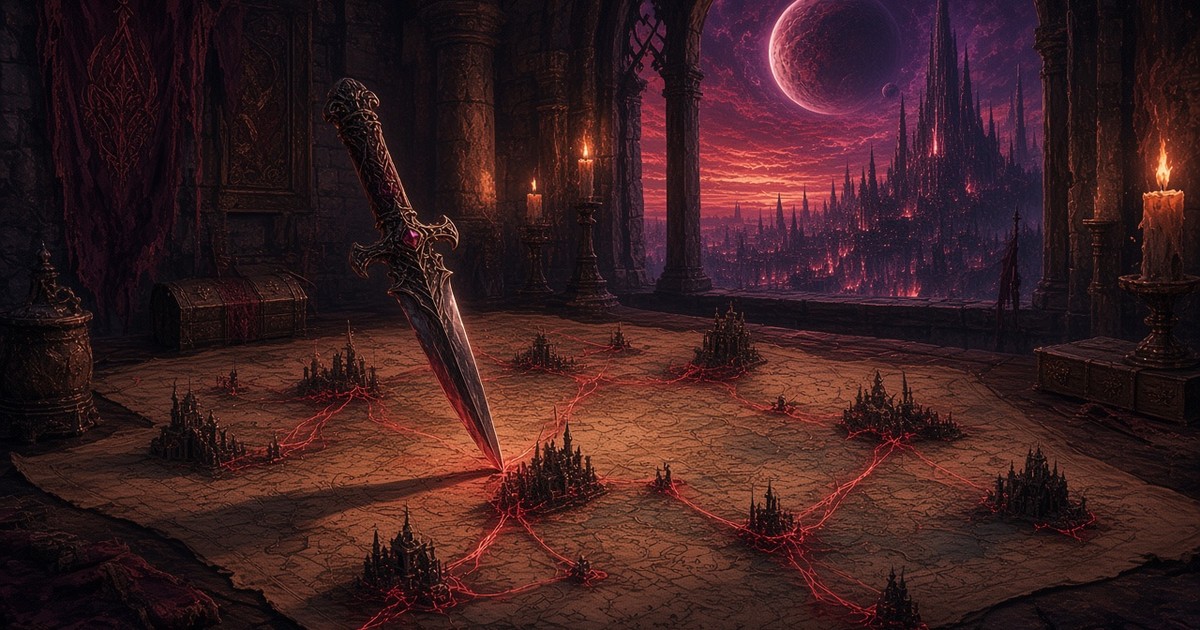
A dagger pins a fantasy map on a war table, its miniature citadels linked by glowing red threads, while a spired city and moon fill the window beyond.

By Jackson Dix

Speculative novels have a plotting problem other genres don’t. Before anything happens, the reader has to learn how the world works. That pulls the opening toward explanation, and explanation pulls the middle toward wandering. By the time the climax arrives, the story has spent so much effort on the world that the ending feels like it belongs to a different book.

One fix is to plot backward. Decide what the climax is first. Then work out what has to be true for that climax to happen, and keep asking that question until you reach page one. Every scene you keep is one the ending needs.

This isn’t the only way to plot a novel, and it doesn’t suit every writer. Some people find their story by drafting. But if you’ve got a setting, a few characters, and no idea how to turn them into a fantasy novel plot or a science fiction one, this method gives you a spine fast.

The post walks through the build in four stages. The running illustration is an invented fantasy setup, made up for this post.

The illustration setup

The city of Lantry is built on a river spanned by living bridges, grown from trees and kept alive by bridge-wardens. A blight is killing the bridges one by one. Kesset, an apprentice warden, is the main character. That’s all we know at the start, which is about where most plots begin: a world, a problem, and a person.

Stage 1: Choose the climax

Start with the scene the whole book is heading toward. You don’t need every detail. You need three things.

What happens

Write the climax as one or two sentences of action. Not a theme. Something a reader could summarize afterward.

What it costs

A climax should force the main character to give something up. If the hero can win without losing anything, the ending will feel light.

How it uses the world

In SFF, the climax should depend on something that only exists in your setting. If you could move the ending to a contemporary city and nothing changes, you’re not using your world. Tolkien’s The Lord of the Rings is a famous case of an ending bound to a rule: the Ring can only be destroyed where it was made. That single rule decides where the whole story has to go. Building rules with clear costs and limits, as covered in Worldbuilding Rules: How to Build Magic and Tech That Hold, gives you material for this.

Illustration

The climax: Kesset discovers the blight can be stopped only by grafting a living warden into the oldest bridge. She does it herself. She saves the city’s bridges and becomes part of one. The cost is her human life. The world rule is the bond between wardens and bridges, which the book will need to set up early.

Stage 2: Find the midpoint turn

With the ending in hand, look for the middle. The midpoint is where the story changes direction. The character learns something, or something happens, that changes what they’re trying to do.

Ask what the character must learn

The climax depends on knowledge or a decision the character doesn’t have at the start. The midpoint is often where that knowledge arrives, or where the first half of it does.

Make it reverse the first half

A strong midpoint makes the goal of the first half look wrong or incomplete. The character was chasing one thing. Now they know they need something else.

Illustration

In the first half, Kesset and the wardens believe the blight is a disease and hunt for a cure. At the midpoint, Kesset finds old records showing the bridges were first grown around living wardens. The blight isn’t a disease. The bridges are starving for the bond they were built on. The goal changes from “find a cure” to “find out what the bridges need,” and the reader can feel where that’s heading.

If you’re also building a character arc, the midpoint is a good place for a false win, where the character gets what they wanted under their old belief and it goes wrong. See Character Arcs in SFF: Map the Belief That Has to Change for how that works.

Stage 3: Build the pressure in between

Now you have three fixed points: the start, the midpoint, and the climax. The gaps between them are where most novels sag. Fill them with a ladder of escalating pressure.

Use try and fail

The simplest building block is a try that fails. The character attempts something toward their goal. It fails, or it succeeds with a cost, and the situation gets worse. Then they try again with what they learned. Each attempt should be bigger and riskier than the one before.

Raise one kind of stakes at a time

Stakes can rise in different ways: more people at risk, more personal cost, less time. Raising all of them every chapter flattens the effect. Pick one per sequence and push it.

Give the antagonist a plan

If your story has an antagonist, they should be working toward their own goal in these gaps, not waiting for the hero. Their progress adds pressure without new setup. A villain with a concrete want and a deadline makes this much easier. See Writing Villains Who Want Something: An SFF Build Sheet for a method.

Illustration

Between the start and the midpoint:

  1. Kesset’s team tries a known cure on a sick bridge. It fails, and the bridge collapses with people on it.
  2. The city council blames the wardens and cuts their funding. Kesset tries to treat bridges in secret and gets caught.
  3. A rival guild of engineers offers to replace the bridges with stone. The council agrees, which means cutting down the living bridges for good.

Between the midpoint and the climax:

  1. Kesset tries to tell the wardens what she found. They refuse to believe her.
  2. She tests a partial bond with a small bridge and nearly dies. It works for a few days.
  3. The engineers begin felling the oldest bridge. Time runs out.

Each step makes the situation worse and pushes Kesset toward the choice the climax needs.

Stage 4: Write the opening last

With everything else in place, you can build the opening. You now know what the ending needs the reader to have learned, so the opening’s job is clear.

Set up what the climax uses

List every world rule, object, and relationship the climax depends on. Each one should appear early, ideally in a scene where it does something. Readers accept a climax built from parts they’ve already seen.

Start with the problem, not the history

SFF openings often spend pages on how the world came to be. Start with the main character inside the problem instead. Explain the world only as much as each scene needs.

Show what the character stands to lose

The climax costs the character something. The opening should show the reader that thing, so the cost lands later.

Illustration

The opening: Kesset climbs a bridge at dawn to tend it and feels the faint pulse of the tree through her hands, which is a sensation only wardens have. She spots the first blight mark. In one scene the reader learns the bond exists, sees the threat, and sees what Kesset loves about her life on the bridges. The climax pays off all three.

Common SFF plotting problems

A few problems show up often in speculative novels.

The world stops the story

If a chapter exists only to explain the setting, cut it or fold the information into a scene where something happens. Every chapter needs a change in the situation.

The stakes keep growing

It’s tempting to escalate from a city to a kingdom to the world to the universe. Bigger isn’t always stronger. A personal cost the reader cares about can hit harder than a galaxy in danger.

The ending depends on a new rule

If the climax uses a power or fact the reader has never seen, it reads like a cheat. Go back to stage 4 and plant it early.

The series hook eats the ending

If you’re writing a series, each book still needs its own climax. A hook for the next book can sit after the climax. It can’t replace it.

FAQ

Should I outline my novel or write without one?

Either can work. Some writers find their story by drafting, then revise. Others need a plan first. Plotting backward from the climax is useful if you have a setting and characters but don’t know where the story goes, or if a draft has stalled in the middle.

How do I outline a science fiction novel with a complex world?

Start with the climax and list the world rules it depends on. Build the plot around those rules and leave the rest of the setting in your notes. The reader only needs the parts of the world the story uses.

What is a midpoint in a novel?

The midpoint is a turn near the middle of the story where the character learns something or an event changes what they’re trying to do. It often makes the goal of the first half look wrong or incomplete and points toward the climax.

How do I fix a sagging middle?

Use try and fail. Give the character a series of attempts toward their goal, each one failing or costing more than the last. Give the antagonist an active plan in the same chapters, so pressure grows even when the hero is not in danger.

Character Arcs in SFF: Map the Belief That Has to Change

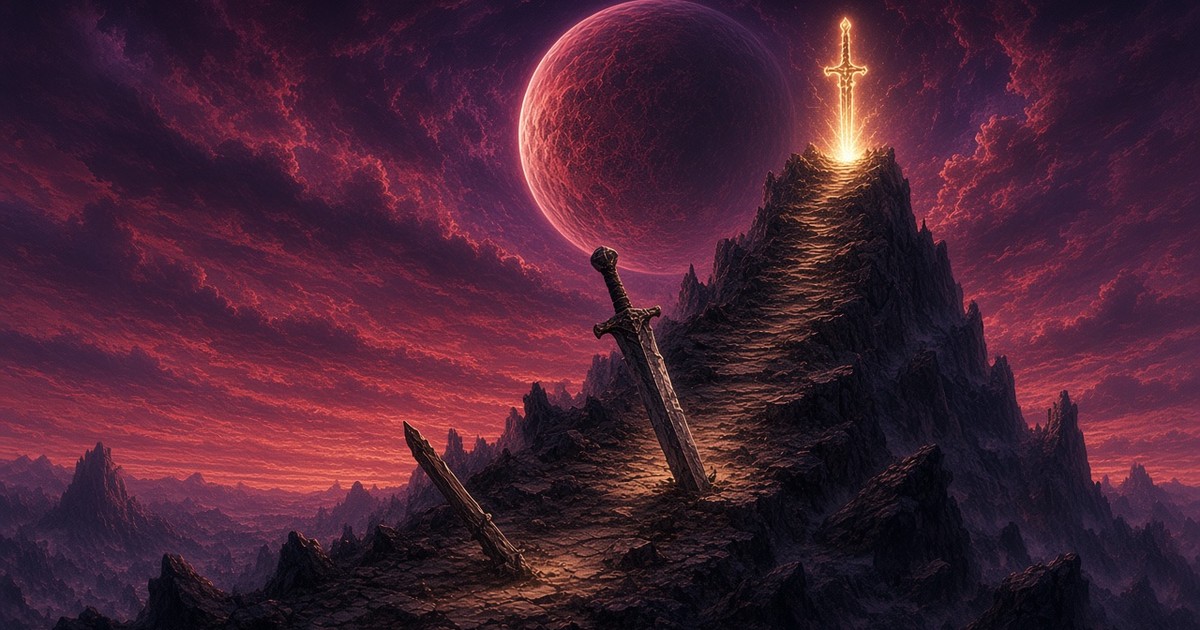
Along a rocky mountain path under a crimson moon, a broken wooden sword, a worn iron sword and a radiant blade at the summit mark a journey of transformation.

By Jackson Dix

A character arc is a change in what a character believes, shown through what they choose. That’s the definition this post works from. It leaves out a lot of theory on purpose, because the working version is what you need at the desk.

Notice what the definition doesn’t say. It doesn’t say the character gets stronger, learns a skill, or levels up. In science fiction and fantasy it’s easy to mistake power growth for an arc. The farm kid becomes a great swordsman. The cadet becomes an admiral. Those are changes in ability. An arc is a change in the person using the ability.

This post is organized around a tool I’ll call the belief map. It has four points: the starting belief, the pressure, the false win, and the proving choice. After walking through the map, we’ll look at the three arc shapes it can produce and at what’s special about character development in fantasy and science fiction.

The illustrations come from one invented character, so you can watch a single arc build from start to finish.

The illustration character

Meet Orla Teague, a salvage pilot in an asteroid belt where a dead alien civilization left wreckage drifting for thousands of years. Orla strips the wrecks for parts and sells them. She’s good at it. She works alone.

She’s an illustration, made up for this post. Keep her in mind as we build the map.

Point 1: The starting belief

Every arc starts with something the character believes that shapes how they act. It works for them, at least partly, or they would have dropped it. It’s also limited or wrong in a way the story will expose.

Write it as one sentence in the character’s own voice. Avoid labels like “she has trust issues.” Write what she’d actually say.

How to find it

Look at the character’s habits. What do they always do? What do they never do? A belief sits under every repeated choice. If your character always works alone, ask what they believe that makes working alone feel safe.

Illustration

Orla’s belief: “Anyone who gets close to you will eventually take a share of what’s yours.” She learned it from a crew that left her stranded when she was young. It has kept her alive and solvent for a decade. It has also kept her alone.

Point 2: The pressure

A belief doesn’t change because a character thinks about it. It changes because the story pushes on it again and again until holding it costs more than letting it go.

Pressure comes from events that make the old belief expensive. Each one should be harder to dismiss than the last. Early pressure can be shrugged off. Late pressure can’t.

Where SFF gives you extra pressure

Your setting can apply pressure that a contemporary story can’t. A magic system can demand a price the character won’t pay alone. A technology can force strangers to depend on each other. A world rule can make the old belief literally dangerous. If you’ve built your setting’s rules with clear costs and limits, as covered in Worldbuilding Rules: How to Build Magic and Tech That Hold, those costs and limits make good pressure points.

Illustration

Orla finds a wreck with a working alien engine, the find of a lifetime. It takes three people to move it, and it’s in a zone patrolled by a salvage cartel. She has to hire a crew. Then the crew proves useful. Then one of them saves her life at personal cost. Each event makes “anyone close will take a share” harder to believe.

Point 3: The false win

Somewhere in the middle of the story, the character often gets what they think they want while still holding the old belief. It looks like victory. It isn’t.

The false win matters because it shows the reader the old belief can succeed on its own terms, and that success is hollow or dangerous. It also sets up the fall that follows.

What it looks like

The character wins by doubling down on the old belief. They push someone away and it works. They hoard the treasure and get away with it. Then the cost arrives.

Illustration

Orla cuts her crew out of the deal and sells the engine’s map to a buyer behind their backs. She’s rich. She’s also just handed the cartel the location of the wreck, and her former crew is still out there working it. The false win puts the people who saved her in danger.

Point 4: The proving choice

The arc completes when the character makes a choice they could not have made at the start. That choice has to cost something real. If changing is free, the reader won’t believe it happened.

The proving choice is the most important scene in the arc. Build toward it from the first chapter. Make sure the old version of the character would choose differently, and make sure the reader knows it.

Test it

Ask: if the character from chapter one stood in this moment, what would they do? If the answer is the same as what your character does now, the arc hasn’t landed.

Illustration

Orla flies back into the cartel’s zone to warn her crew, which means losing the money from the sale and probably her ship. Chapter-one Orla would have stayed clear and kept the money. This Orla gives up her share to protect people who are close to her. The belief has flipped, and the reader saw it happen through a choice.

The three arc shapes

The belief map can produce three shapes, depending on where the belief ends up.

Positive arc

The character drops a limiting belief and adopts a truer one. Orla’s arc above is positive. A classic public domain example is Ebenezer Scrooge in Charles Dickens’s A Christmas Carol. The story uses supernatural visitors to pressure his belief about money and people until he chooses differently. It’s a good model for how speculative elements can drive an arc.

Negative arc

The character holds on to the old belief, or swaps it for a worse one. Pressure makes them harder instead of wiser. The proving choice proves they’ve fallen. Oscar Wilde’s The Picture of Dorian Gray, also public domain, is a famous case. The supernatural portrait shows the cost of each choice while the character keeps choosing the same way.

Illustration

A negative version of Orla would answer every pressure by pulling further away. In the end she sells out her crew a second time, to the cartel, and survives alone and rich. The arc is complete, and it’s a tragedy.

Flat arc

The character’s belief is already true. Instead of changing, they hold to it under pressure and change the world or the people around them. Flat arcs are common in adventure fiction, where the hero is steady and the story tests that steadiness.

Illustration

Picture a flat version where Orla’s crewmate Desh is the main character. Desh believes from page one that people survive the belt by sharing. The story pressures that belief hard, and Desh holds it. By the end, Orla is the one who changes, because Desh didn’t.

Arcs and the rest of the story

An arc doesn’t run on its own track. It should cross the plot at every major turn.

Tie arc beats to plot beats

The pressure events in the arc are usually plot events too. The false win often sits near the story’s midpoint. The proving choice usually sits at or near the climax. If your arc beats and plot beats happen in different scenes, look for ways to merge them. For a structure that lines these up, see Plotting SFF Novels: Plot Backward From the Climax.

Give the antagonist a belief too

A villain with a clear belief can act as a mirror for the hero’s arc. Orla’s cartel boss might hold her exact starting belief and have taken it to its end. Facing him shows Orla where her own path leads. See Writing Villains Who Want Something: An SFF Build Sheet for a full method on building a villain who wants something.

Don’t rush the change

The most common problem in a character arc is a change that happens in one scene with no build. If your character changes their mind after a single conversation, add pressure events earlier. Change should feel slow, then sudden.

The belief map, in one block

Copy this into your notes for each main character.

BELIEF MAP

Starting belief (one sentence, in their voice):
Where it came from:
Pressure events (3 or more, each harder to dismiss):
False win (what they get while holding the old belief):
Cost of the false win:
Proving choice (what they choose that they couldn't before):
What it costs them:
Arc shape (positive, negative, flat):

FAQ

What is a character arc?

A character arc is a change in what a character believes, shown through the choices they make. Growth in skill or power is not an arc by itself. The arc is complete when the character makes a choice they could not have made at the start of the story.

Does every character need an arc?

No. Main characters usually need one, either a change or a tested belief that holds. Supporting characters can have smaller arcs or none. A flat arc, where the character’s belief holds firm and changes others, is also a complete arc.

How is character development in fantasy different from other genres?

The core is the same: a belief under pressure. Fantasy and science fiction add tools. A magic system’s costs, a technology’s limits, or a world rule can pressure a belief in ways contemporary settings can’t. Use the setting to make the old belief expensive.

How do I write a character arc without making it predictable?

Make the false win feel real. If the old belief appears to succeed in the middle of the story, the reader isn’t sure the character will change. Then make the proving choice cost more than the reader expected.

Worldbuilding Rules: How to Build Magic and Tech That Hold

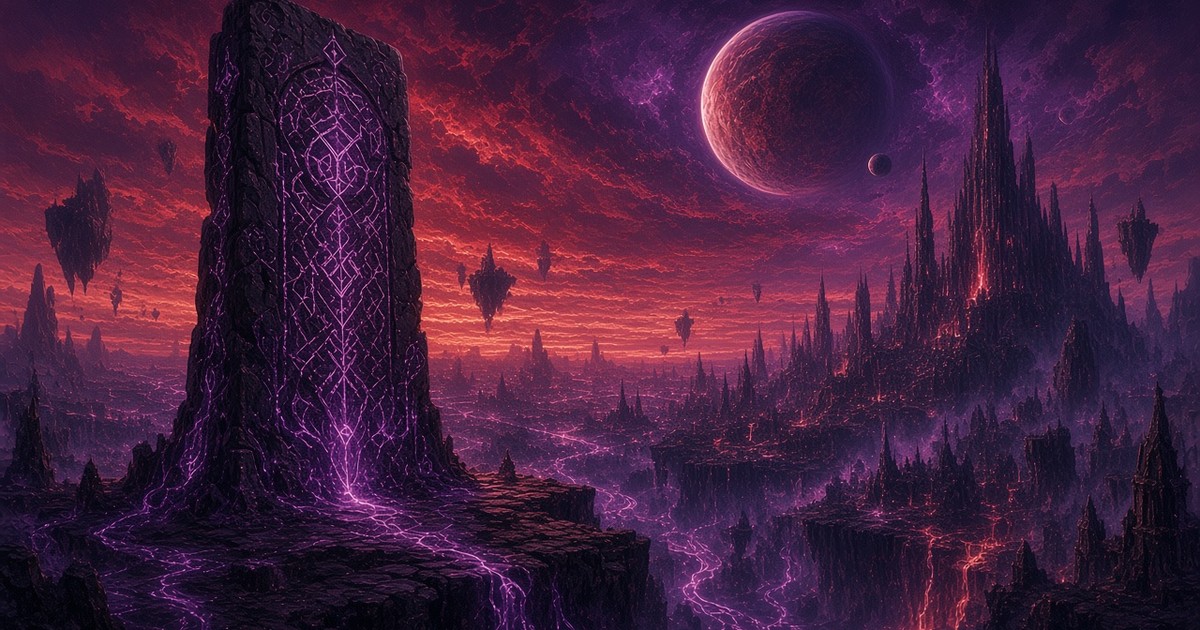
A towering stone monolith etched with glowing violet patterns stands over a spired dark kingdom and floating islands beneath a looming moon.

By Jackson Dix

There are two halves to worldbuilding. One is texture: food, weather, slang, what people do on holidays. The other is rules: what is possible in this world, what it costs, and who controls it. Texture makes a setting feel lived in. Rules make the plot work.

This post is about the rules half. If you’re working out how to build a fantasy world, or a science fiction one, it’s the half to settle first. A rule is anything in your setting that changes what a character can do. A spell, a faster-than-light drive, a law about who can own land, a curse that kills anyone who lies under a full moon. If it changes a character’s options, it’s a rule, and readers will test it.

Readers test rules the way players test a game. They notice when a hero could have solved chapter four’s problem with the trick from chapter nine. They notice when a technology that ended a war in the prologue is never mentioned again. You don’t need a fifty-page appendix to avoid this. You need to ask each rule a few hard questions before you lean on it.

Below are five questions I run on every major rule in a setting. For each one there’s an explanation, an original illustration, and a quick fix if the rule fails. The illustrations come from two settings invented for this post: a fantasy city where spoken promises are binding magic, and a far-future colony that runs on borrowed time.

Question 1: What does it cost?

A rule with no cost becomes the answer to every problem. If teleportation is free, why does anyone ride a horse? If the healer can fix any wound, why is anyone afraid of a sword?

Cost doesn’t have to mean money. It can be time, pain, memory, years of life, social standing, or a debt to someone dangerous. The best costs hurt the character who pays them in a way that matters to the story.

Illustration: the debt city

In the city of Harrowgate, any spoken promise witnessed by two people becomes binding. Break it and you lose the use of your hands until you make it right. The cost of using this power is that you can only bind others by binding yourself. Every contract has two sides. A rich merchant who holds a hundred promises also owes a hundred.

The fix if it fails

If your rule costs nothing, attach a cost that grows with use. Small uses are cheap. Big uses are expensive. That alone keeps the rule from flattening your climax.

Question 2: What are its limits?

Cost answers “what do you pay?” Limits answer “what can’t it do, at any price?”

Limits are where your plot lives. A hero can’t solve a problem with magic if the problem sits outside magic’s reach. Ursula K. Le Guin’s Earthsea books are a well-known case. Magic there works through true names, so a wizard’s power ends where his knowledge of names ends. That single limit shapes what wizards study, what they fear, and what they can’t fix.

Illustration: the borrowed-time colony

On the colony world Tenley, a device called a lender can slow time inside a small field. A medic can stretch one minute into an hour to perform surgery. The limits: the field can’t be larger than a room, it can’t run for more than six hours of outside time, and nothing living can cross its boundary while it runs. That last limit is the one the plot uses. A character trapped inside a field when the colony is attacked can’t get out to help.

The fix if it fails

Write down three things the rule can never do. Then check that at least one of them gets in your protagonist’s way at a moment that hurts.

Question 3: Who controls it?

Every rule creates winners and losers. Ask who has access, who is shut out, and who profits from keeping it that way.

This question turns a magic system or technology into politics, and politics gives you conflict without needing a villain to invent it. Frank Herbert’s Dune is a famous example. The spice is needed for space navigation and comes from one planet, so every faction in the galaxy has a reason to fight over that planet. The rule creates the empire’s politics.

Illustration: the debt city

In Harrowgate, the Witness Guild licenses who may serve as a witness to a binding promise. Without two guild witnesses, a promise is just words. So the guild controls every contract in the city. Unlicensed witnessing is a crime. A street kid who discovers that her testimony binds just as well as a guild member’s has found something the guild will kill to hide.

The fix if it fails

If anyone can use your rule equally, ask what would happen in a real society. Someone would try to control it. Someone would try to tax it. Write down who that is.

Question 4: What has it changed?

A rule that has existed for centuries would reshape the world around it. Architecture, law, religion, crime, warfare, and daily habits would all adapt.

This is where many settings break. The author adds a powerful rule and then writes a society that looks like it never had it. If healing magic is common, life expectancy changes, medicine changes, and the way wars are fought changes. If people can read minds, privacy works differently and so does a courtroom.

You don’t have to show every change. Pick a few and show them in passing. Readers fill in the rest.

Illustration: the borrowed-time colony

On Tenley, schools use lenders for exams so students can take a three-hour test in thirty outside minutes. Prisons are lenders run in reverse: one outside day, a week inside. Lovers on night shifts rent small fields to stretch an evening. None of this is plot. It’s a few lines in different scenes that make the device feel old.

The fix if it fails

For each major rule, write one change in each of these areas: work, law, and daily life. Use them as background details. Add more areas if the rule is big enough to need them.

Question 5: Where does it break?

Rules that never break can’t surprise anyone. The most interesting moments in a speculative plot often come when a rule does something its users didn’t expect.

This isn’t the same as cheating. A rule that breaks in a way the author set up earlier feels earned. A rule that breaks only when the plot needs a rescue feels like a cheat. Isaac Asimov built many robot stories around this. The Three Laws of Robotics were clear, and the stories came from situations where the laws produced strange results nobody planned for.

Illustration: the debt city

Harrowgate’s promise magic binds anyone who speaks a promise in front of two witnesses. Nobody has thought about what happens when the promise is made to the city itself. The founder of Harrowgate did exactly that three hundred years ago, and the promise was never fulfilled. That’s the secret your protagonist uncovers in act three, and it works because the rule was stated plainly in chapter one.

The fix if it fails

Find the edge case. What happens when the rule meets itself, meets another rule, or meets a situation its creators never imagined? Plant that edge case early, then use it later.

Writing the rules into the story

Once your rules pass these questions, you still have to get them onto the page without stopping the story for a lecture. A few habits help.

Show the rule before you need it

If a rule will save or doom someone in the climax, show it working in a low-stakes scene first. The reader learns how it works while nothing is on the line. When it matters, they already understand.

Let characters disagree about it

People in your world won’t all understand the rules the same way. A priest, a scientist, and a smuggler might explain the same magic three different ways. That conflict teaches the reader and builds character at once.

Keep a rules file

Write each rule, its cost, its limits, who controls it, what it changed, and where it breaks. One page per rule. Check it when you draft scenes that use the rule. This is the least glamorous part of building a setting and the one that saves the most revision time.

Tie at least one rule to your antagonist

The strongest SFF antagonists understand a rule better than anyone or exploit a gap in it. If your villain could be dropped into a story with no speculative elements, you’re not using your setting. See Writing Villains Who Want Something: An SFF Build Sheet for a full method on building a villain around a world rule.

How rules connect to plot and character

Rules don’t sit apart from the rest of your story. A cost should force a character to choose. A limit should block a plan. A break should change what the reader thought was possible.

When you outline, look for places where a rule can create pressure. The plot tends to come out of the gap between what a character wants and what the rules allow. For how to build a plot around that gap, see Plotting SFF Novels: Plot Backward From the Climax. For how a rule can shape what a character believes and how that belief changes, see Character Arcs in SFF: Map the Belief That Has to Change.

FAQ

How many rules should a magic system have?

Enough to cover what the story uses. A magic system needs clear costs and limits for every power that affects the plot. Powers that only add texture can stay vague. If a power solves or causes a major problem, define it.

Do science fiction settings need rules as strict as fantasy magic?

Yes. A faster-than-light drive, a mind upload, or an AI is a rule in the same sense a spell is. Readers will check its costs, limits, and effects on society just as hard. The vocabulary changes, but the questions are the same.

How do I explain my world’s rules without an info dump?

Show each rule working in a low-stakes scene before the story depends on it. Let characters argue about how it works. Give the reader only what they need for the next scene, and trust them to collect the rest.

What if I break my own rule by accident?

Fix it in revision by either changing the scene or changing the rule. If the break makes the story better, plant the edge case earlier so it reads as a discovery instead of a mistake. A rules file makes these breaks easier to catch.